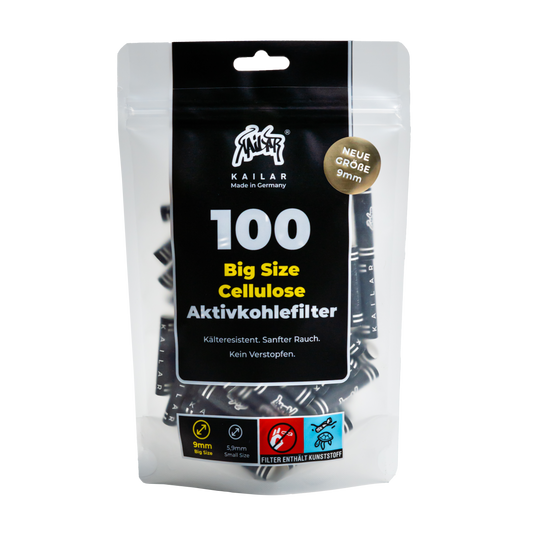
You have probably heard that activated carbon filters reduce pollutants. But how much is "reducing" actually? And what happens to THC, taste and draw resistance?
We are Kailar — we develop and produce cellulose activated carbon filters in Germany. In this guide we explain how activated carbon works, what filters differ, and what you should pay attention to when choosing.
How does activated carbon work?
Activated carbon is a highly porous material with a huge inner surface — a single gram has up to 3,000 m2 of surface, equivalent to about half a football field.
When air flows through the filter, passes Adsorption: Pollutants remain on the surface of the coal. Not all substances are the same — larger molecules such as tar and formaldehyde are better bound than smaller gas molecules.
Important: Adsorption is not the same as absorption. Pollutants are not absorbed, but are held to the surface — like a magnet, not a sponge.
What activated carbon is known for
Activated carbon is used in many areas — from water filters to air purification. The principle is always the same: certain substances stick to the porous surface, others pass unhindered. In the context of filters for joints, this means that larger molecules such as tar and condensate are bound while smaller molecules are allowed through.
What happens to THC and taste?
- THC and CBD pass through the activated carbon — the molecules are too small to hang from the pores
- Terpene (the flavourings) are hardly affected
- Carbon monoxide (CO) is also too small for the pores
As a result, the draw becomes softer and cleaner, the taste remains unchanged, the effect remains the same.
Activated carbon filter vs. cardboard filter — the difference
A normal cardboard filter tip is basically a spacer. It prevents loose material from entering the mouth, but it does not filter anything on a molecular level.
An activated carbon filter works differently: the porous coal binds substances by adsorption. The difference is noticeable at the first draw — the taste is cleaner, the draw cooler, and it scratches less in the neck.
Important: We do not make any health promises here. If you want to get more detailed information, you will find studies on the mode of action of activated carbon using public sources. What we can say: The difference to a cardboard filter is immediately noticeable.
6mm vs. 9mm — What diameter fits?
The size of your filter directly affects how much activated carbon is in it and how the draw feels.
6mm (Slim)
- Fits in standard joints and hand-rolled cigarettes
- Less activated carbon, but sufficient for most applications
- Lighter train, less resistance
- Best for: Everyday use if you want a normal draw
9mm (Big Size)
- Significantly more activated carbon — 2 to 4 times as much as a 6mm filter
- Stronger filtration, cooler and gentler train
- A little more draw resistance
- Best for: Pipes, Blunts, or if you want maximum filtration
Rule of Thumb
When you're the first time you're Activated Carbon Filters Try to start with 6mm. If you already filter and want more effect, switch to 9mm.